By John DeLooper
This was the last day of the great microgravity adventure.
Each team was required to make a presentation on its work activity. It could be in any format, but ingenuity was encouraged. Twelve teams were required to present. Some teams chose PowerPoint presentations, and some home-made movies. The Space Cowboys chose to have a campfire and a sing-a-long with s'mores!
We did have some VIP's in the audience including Kumar Garg, a policy analyst from the Office of Science and Technology Policy, and Leland Melvin, an astronaut who is now the Associate Administrator for Education in NASA.
When it was our turn, my wonderful teammates invited Leland to become an honorary Space Cowboy - he accepted and helped us perform our campfire songs. Our team performed the classic, "Fly Zero - G," "We've Been Working on our Project," and "Fly, Fly, Away," each with great audience participation. A picture of the Space Cowboys including Leland is below - he's in the white shirt with a tie and cowboy hat.
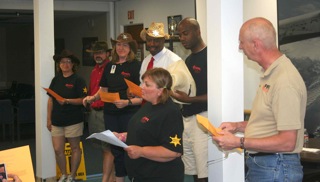
So here are the words to "Fly Zero - G" (to the tune of "Home on the Range"):
Oh, give us our meds,
For our dizzying heads,
So we can fly and not worry or puke
Where our team's never late
And our projects just great
And our data is accurately clear
Fly, fly, zero g
Where we'll float and then we will spin
With bubbles galore
Coils, springs and much more
And we're ready to do this again.
After our songs, we thanked the NASA and DOE for this wonderful opportunity. It was truly an amazing experience.
But the work was not done yet. We still had to pack all of our hardware up and get it ready for shipment. As we did that, we took one last picture of all the teams associated with the Department of Energy with our hosts from the Reduced Gravity Office. All of the team members signed the banner which will now be hung in the high bay of the RGO.
Now we are done. Allison is on her way home. The rest of us travel tomorrow. The adventure is complete. But a few of us are already thinking of ideas and possible funding to get other experiments on this wonderful laboratory! Thanks to the RGO for a wonderful experience and a great memory!
Sunday, July 31, 2011
Saturday, July 30, 2011
Farewell with banner flying
By Adam Cohen
Today, we had the final presentations from the teachers on their experimental results, and we bid farewell to our NASA hosts. What an incredible experience - top to bottom (to top to bottom to ......). We left the Reduced Gravity Office folks with a PPPL banner that flew on the ZeroG, signed by all the participants, so when future PPPL teams go, they will see the banner flying high in the hangar!! (If you look closely, you can see me playing lacrosse, at least, I think that's me......) Lots of stories, photos and memories to share with the PPPL community.
Friday, July 29, 2011
Johnson Space Center
By Adam Cohen
Yesterday we had two flights to stay ahead of the storm - literally: Tropical Storm Don is expected to deliver a bunch of rain to Houston today. We also had a bit of a behind-the-scenes tour at the Johnson Space Center, and saw the mock-up facility, the neutral buoyancy lab (where they simulate moving in space by being underwater) and the control rooms for both the International Space Station and the historic Apollo mission control. Here I am standing at the communication officers panel.
I wonder if anyone ever pushed the button I'm pushing, which is......
Does anyone know if we had one of these in the TFTR Control Room, back in the day???
Yesterday we had two flights to stay ahead of the storm - literally: Tropical Storm Don is expected to deliver a bunch of rain to Houston today. We also had a bit of a behind-the-scenes tour at the Johnson Space Center, and saw the mock-up facility, the neutral buoyancy lab (where they simulate moving in space by being underwater) and the control rooms for both the International Space Station and the historic Apollo mission control. Here I am standing at the communication officers panel.
I wonder if anyone ever pushed the button I'm pushing, which is......
Does anyone know if we had one of these in the TFTR Control Room, back in the day???
July 28 Mission Control
By Patti Wieser
PPPL team teacher-researcher Matt VanKouwenberg is at the controls in the Apollo Mission Control Center at the Johnson Space Center. — Photo by Patty Hillyer
Banks of controls and small blank computer screens filled the room, facing large screens. We were touring the Apollo Mission Control Center at the Johnson Space Center this afternoon while the last of our groups conducted their experiments aboard a zero-G flight. Dial phones, along with pneumatic tubes for sending messages — similar to those used at banks in the drive-through — were scattered among all the buttons on the government green consoles. One of the NASA guides said young visitors usually don’t know what the dial is. She said, too, that the message tubes sometimes had transported cigarettes and “other things” when the room operated.
The room has been designated a National Historic Landmark.
It reminded me of the old PBX — Princeton Beta Experiment — Control Room at PPPL, which was dismantled several years ago. It, too, had small screens for black-and-white-only images and data.
So much history — and so many wonderful discoveries — in space exploration and fusion research.
The last zero-G flight for our teams was this afternoon instead of tomorrow morning, bumped up because of storms in the forecast.
Tomorrow the teams make their final presentations.
What a week it has been.
PPPL team teacher-researcher Matt VanKouwenberg is at the controls in the Apollo Mission Control Center at the Johnson Space Center. — Photo by Patty Hillyer
Banks of controls and small blank computer screens filled the room, facing large screens. We were touring the Apollo Mission Control Center at the Johnson Space Center this afternoon while the last of our groups conducted their experiments aboard a zero-G flight. Dial phones, along with pneumatic tubes for sending messages — similar to those used at banks in the drive-through — were scattered among all the buttons on the government green consoles. One of the NASA guides said young visitors usually don’t know what the dial is. She said, too, that the message tubes sometimes had transported cigarettes and “other things” when the room operated.
The room has been designated a National Historic Landmark.
It reminded me of the old PBX — Princeton Beta Experiment — Control Room at PPPL, which was dismantled several years ago. It, too, had small screens for black-and-white-only images and data.
So much history — and so many wonderful discoveries — in space exploration and fusion research.
The last zero-G flight for our teams was this afternoon instead of tomorrow morning, bumped up because of storms in the forecast.
Tomorrow the teams make their final presentations.
What a week it has been.
Thursday, July 28, 2011
The Day After
By John DeLooper
Everyone who has flown has recovered from the medications - everyone was tired last night.
Today we went to the Johnson Space Center for a professional development session for the teachers. The speaker covered all of the resources that are available from the education centers at NASA as well as a hands-on experiment on some toys that have been tested in microgravity in the space station. The teachers had to guess what happens to the toy in space and then they showed the video of what actually happened.
The B teams flew today. But instead of having one flight, a decision was made to move the Friday flight up to this afternoon. This was done because of the impending storm "Don" that is moving into the designated flight pattern. Both flights were accomplished - Aliya flew in the morning and Andrew flew in the afternoon.
During the afternoon we got the official tour of some NASA facilities. We were able to go into an engineering facility that has life-size mockups of the space station and the Russian transport vehicle. This is where they go through flight plans with the astronauts and develop engineering solutions.
We traveled by bus to the neutral buoyancy lab where the astronauts do training in their suits for outside the space station. This pool is over 100 feet wide, 200 feet long and 40 feet deep. Unfortunately, all of the training was done for the day by the time we arrived.
Back into the bus to mission control to see the folks controlling the space station. Our tour guides explained each of the positions and activities that could be accomplished from the room - they can control the hardware on the station.
Above this control room is the historic control room for the Apollo program. We were able to enter this and see the actual room in which history was made - man landing on the moon as well as bringing back the Apollo 13 crew. Over the water cooler is a mirror from the Apollo 13 crew that was pulled from the lunar module to make up the weight since they did not have rocks from the moon. It was put in the control room to remind the controllers that the real heroes were the folks in the mission control room.
This was an impressive tour.
Everyone who has flown has recovered from the medications - everyone was tired last night.
Today we went to the Johnson Space Center for a professional development session for the teachers. The speaker covered all of the resources that are available from the education centers at NASA as well as a hands-on experiment on some toys that have been tested in microgravity in the space station. The teachers had to guess what happens to the toy in space and then they showed the video of what actually happened.
The B teams flew today. But instead of having one flight, a decision was made to move the Friday flight up to this afternoon. This was done because of the impending storm "Don" that is moving into the designated flight pattern. Both flights were accomplished - Aliya flew in the morning and Andrew flew in the afternoon.
During the afternoon we got the official tour of some NASA facilities. We were able to go into an engineering facility that has life-size mockups of the space station and the Russian transport vehicle. This is where they go through flight plans with the astronauts and develop engineering solutions.
We traveled by bus to the neutral buoyancy lab where the astronauts do training in their suits for outside the space station. This pool is over 100 feet wide, 200 feet long and 40 feet deep. Unfortunately, all of the training was done for the day by the time we arrived.
Back into the bus to mission control to see the folks controlling the space station. Our tour guides explained each of the positions and activities that could be accomplished from the room - they can control the hardware on the station.
Above this control room is the historic control room for the Apollo program. We were able to enter this and see the actual room in which history was made - man landing on the moon as well as bringing back the Apollo 13 crew. Over the water cooler is a mirror from the Apollo 13 crew that was pulled from the lunar module to make up the weight since they did not have rocks from the moon. It was put in the control room to remind the controllers that the real heroes were the folks in the mission control room.
This was an impressive tour.
Wednesday, July 27, 2011
The Big Day
By John DeLooper
Today was the day. The first briefing was by the flight director explaining what was going to happen, to relax, to breathe and make sure we don't develop tunnel vision - his words of advice - to make a memory because this probably will be the one and only time you will do this. There was a however.... you need to be working on your research ...the reason we are here. As he explained, you are government personnel and you are using a government laboratory - make the most of it.
Then the doctor came in and reviewed a number of items and handed out the medications to try to ward off motion sickness. Everyone, except one, took the meds.
The steward of the plane then briefed us on safety equipment, the hoods for emergency oxygen and the very, very limited bathroom facilities. Then the famous march to the plane with the NASA folks as well as our staff, who recorded it with photos and video.
As we entered the plane we took our seats at the back end of the plane. Below is a picture of what the inside looks like from the seats. Our experiment is the third one - taller glove box. In the picture, Aliya is hanging the banner we had made up. On Friday, we'll all sign it and hang it in their "high bay" room.
So we departed, flew to altitude and then had about 10 minutes to start our motion sensors and video cameras (2 sensors and 4 cameras). And then the evolutions began. It was amazing. We completed 30 full microgravity cycles and one Martian and one lunar cycle. Our experiment worked. We still had difficulties - one of our bubble machines fell down, one of our cameras shut down but overall this was a successful experiment. The teachers also got to do some outreach activities using some toys to show the effect of microgravity. Andrew and I tossed a tennis ball back and forth - very cool. We should be getting the NASA video in a couple of weeks to share with others. The approved flight plan which took us over the Gulf of Mexico is shown in the picture below.
Before you knew it, the experimental phase of the flight was done. We cleaned up, shut things down and went back to our seats heading back to the Ellington airfield. We landed and marched out of the plane with the camera folks taking pictures. Then back into the briefing rooms for the post-flight brief. There were a lot of happy people - the teachers who worked with me were very happy, grateful and full of ideas on how to use this in their classrooms. Unfortunately, some folks on the flight did get sick and had a rough time. They were well cared for by the flight surgeon.
After turning in my flight suit, I thanked the steward for his efforts on the flight. I did tease him about a few improvements they might make - didn't get any frequent flyer miles, there was no movie available and there was no inflight magazine to read.....
And by the way, I certainly made a memory.
Today was the day. The first briefing was by the flight director explaining what was going to happen, to relax, to breathe and make sure we don't develop tunnel vision - his words of advice - to make a memory because this probably will be the one and only time you will do this. There was a however.... you need to be working on your research ...the reason we are here. As he explained, you are government personnel and you are using a government laboratory - make the most of it.
Then the doctor came in and reviewed a number of items and handed out the medications to try to ward off motion sickness. Everyone, except one, took the meds.
The steward of the plane then briefed us on safety equipment, the hoods for emergency oxygen and the very, very limited bathroom facilities. Then the famous march to the plane with the NASA folks as well as our staff, who recorded it with photos and video.
As we entered the plane we took our seats at the back end of the plane. Below is a picture of what the inside looks like from the seats. Our experiment is the third one - taller glove box. In the picture, Aliya is hanging the banner we had made up. On Friday, we'll all sign it and hang it in their "high bay" room.
So we departed, flew to altitude and then had about 10 minutes to start our motion sensors and video cameras (2 sensors and 4 cameras). And then the evolutions began. It was amazing. We completed 30 full microgravity cycles and one Martian and one lunar cycle. Our experiment worked. We still had difficulties - one of our bubble machines fell down, one of our cameras shut down but overall this was a successful experiment. The teachers also got to do some outreach activities using some toys to show the effect of microgravity. Andrew and I tossed a tennis ball back and forth - very cool. We should be getting the NASA video in a couple of weeks to share with others. The approved flight plan which took us over the Gulf of Mexico is shown in the picture below.
Before you knew it, the experimental phase of the flight was done. We cleaned up, shut things down and went back to our seats heading back to the Ellington airfield. We landed and marched out of the plane with the camera folks taking pictures. Then back into the briefing rooms for the post-flight brief. There were a lot of happy people - the teachers who worked with me were very happy, grateful and full of ideas on how to use this in their classrooms. Unfortunately, some folks on the flight did get sick and had a rough time. They were well cared for by the flight surgeon.
After turning in my flight suit, I thanked the steward for his efforts on the flight. I did tease him about a few improvements they might make - didn't get any frequent flyer miles, there was no movie available and there was no inflight magazine to read.....
And by the way, I certainly made a memory.
Subscribe to:
Posts (Atom)


