PPPL's Blog Has Moved!
The new blog location is: http://blogs.princeton.edu/pppl/
Thursday, January 23, 2014
Tuesday, February 12, 2013
A Pleasing Disruption: Fusion equations pop up on popular TV show
FUSIONISTA: FUSION IN POP CULTURE
Greg Hammett, a physicist at the Princeton Plasma Physics Laboratory, was minding his own business one recent evening, chilling, watching a TV show popular with Lab folks and many others – the top-rated CBS comedy, The Big Bang Theory (Episode14, titled “The Cooper-Kripke Inversion”.) Suddenly he saw it: Jim Parsons, the actor playing one of the show’s lead characters – a brilliant, though socially awkward theoretical physicist named Sheldon Cooper – was at work in front of a whiteboard. Scrawled across the board in red-orange magic marker were letters and digits representing an idea that Hammett knew quite well. To his great pleasure, Hammett spied an equation he had helped derive in his research on fusion energy. “This equation describes turbulent diffusion in fusion devices and also describes how performance can be improved by sheared flows that can reduce the turbulence,” Hammett said. “The ovals at the bottom of Sheldon’s whiteboard are meant to illustrate this stabilization mechanism – which we are studying as a possible way to improve fusion reactors – and this is an illustration that I’ve used in my talks.”
Many researchers in
the field of plasma physics have contributed to the development of this theory,
fondly known to its adherents as “gyrokinetic turbulence theory.” The key
people who developed this particular equation as well as the computer
simulations backing them, in addition to Hammett, include: Bill Dorland at the
University of Maryland; Mike Kotschenreuther, University of Texas; Mike Beer,
Johns Hopkins University; and Ron Waltz of General Atomics. Dorland and Beer
were former PhD students who worked with Hammett. Kotschenreuther also earned
his doctoral degree from PPPL. And Hamid Biglari, who also played a significant
role in the development of the turbulence improvement mechanism in this
equation, earned his PhD from PPPL. He is now enjoying a prominent career on
Wall Street.
![]() | |
| PPPL Physicist Greg Hammett |
For
Hammett, and other fans of The Big Bang Theory at the Lab, it was a thrill to
see fusion science touched upon in the show, which often intertwines high-level
scientific conversations on topics such as Einstein’s quest for a unified field
theory with young adult obsessions such as finding an attractive date for a
Saturday night.
Another
important Princeton connection is the show’s science writer-consultant, David
Saltzberg, a UCLA physicist and Princeton University graduate who ensures that
the show’s scientific content – including all equations -- is accurate. He obviously is very well read!
Hammett isnt sure exactly where Saltzberg found the formulas and illustrations because they have appeared in many talks he and others have given over the years that are available online, such as a talk Hammett gave in 2005 at the Kavli Institute for Theoretical Physics in Santa Barbara.
But Hammett is thinking broadly, looking to see whether the fusion strand will be woven into future installments. Late in this episode, the character Sheldon speaks with a colleague about ideas for a new fusion reactor design. He starts to explain an approach for reducing turbulence, one of the major research issues for plasma physicists at the moment, but is interrupted. "I don't know if we'll ever learn what brilliant ideas Sheldon had," Hammett said.
Tuesday, January 22, 2013
At JLab where the nucleus is king
FUSIONISTA: Notes from the landscape of the National Labs
I know I am lucky -- part of my job is to occasionally visit my colleagues at other DOE National Laboratories, where I get to meet some of the best scientists in the world and, equally exciting, view their top-notch, one-of-a-kind, supercool equipment.
Earlier this month, I was able to visit Dean Golembeski, director of public affairs at The Thomas Jefferson National Accelerator Facility, a place we call "JLab," mainly so we can converse about it without overly cluttering up our sentences. JLab was kind enough to host a meeting of a group of chief communications officers from all of the DOE's National Labs.
Like the researchers at PPPL, the scientists at JLab are after big game. Physicists there are exploring the innermost realm of matter -- the nucleus of the atom. They think of their work, in the words of accelerator physicist Steve Suhring, as applying a "giant microscope" to nature. Their goal is to discover the origins of matter, improving our understanding of its building blocks and identifying the forces that transform it. It's a lofty goal and a perfect one for a National Lab, where scientists explore basic research for the good of the U.S. and humanity. But how, precisely, do JLab scientists study something as infinitesimal as a nucleus, located at the center of the atom, a speck in itself?
Allow me to show you how JLab does it.
Here, JLab staff scientist Ari Palczewski explains how scientists construct all the basic elements they need to make their accelerator, including supercold vacuum devices known as "cryomodules" and a giant microscope called Cyclops:
http://mediacentral.princeton. edu/id/0_jctuuwgi
JLab accelerator physicist Steve Suhring gives one of the best descriptions I've heard of how an accelerator works, using a mere whiteboard:
http://mediacentral.princeton. edu/id/0_lzs4qkwi
Scientists at JLab may be peering into the ultrasmall, but they definitely think big.
Here's a High Resolution Magnetic Spectrometer that uses electrons to examine matter more closely. It's a whopper, weighing in at 240 tons:
And here is physicist Steve Suhring guiding me and a group of my colleagues deep underground in the long corridor that parallels the accelerator track:
We know that so many of the modern marvels we take for granted -- cell phones, MRI machines, cancer medications -- would never have existed without fundamental scientific research. Leaving JLab, I find myself grateful for the efforts of everyone there and all of the National Labs, toiling to learn and benefit all.
___________________________________________________________________
Fusionista Kitta MacPherson is the director of communications at the Princeton Plasma Physics Laboratory and an award-winning science writer.
I know I am lucky -- part of my job is to occasionally visit my colleagues at other DOE National Laboratories, where I get to meet some of the best scientists in the world and, equally exciting, view their top-notch, one-of-a-kind, supercool equipment.
Earlier this month, I was able to visit Dean Golembeski, director of public affairs at The Thomas Jefferson National Accelerator Facility, a place we call "JLab," mainly so we can converse about it without overly cluttering up our sentences. JLab was kind enough to host a meeting of a group of chief communications officers from all of the DOE's National Labs.
Like the researchers at PPPL, the scientists at JLab are after big game. Physicists there are exploring the innermost realm of matter -- the nucleus of the atom. They think of their work, in the words of accelerator physicist Steve Suhring, as applying a "giant microscope" to nature. Their goal is to discover the origins of matter, improving our understanding of its building blocks and identifying the forces that transform it. It's a lofty goal and a perfect one for a National Lab, where scientists explore basic research for the good of the U.S. and humanity. But how, precisely, do JLab scientists study something as infinitesimal as a nucleus, located at the center of the atom, a speck in itself?
Allow me to show you how JLab does it.
Here, JLab staff scientist Ari Palczewski explains how scientists construct all the basic elements they need to make their accelerator, including supercold vacuum devices known as "cryomodules" and a giant microscope called Cyclops:
http://mediacentral.princeton.
JLab accelerator physicist Steve Suhring gives one of the best descriptions I've heard of how an accelerator works, using a mere whiteboard:
http://mediacentral.princeton.
Scientists at JLab may be peering into the ultrasmall, but they definitely think big.
Here's a High Resolution Magnetic Spectrometer that uses electrons to examine matter more closely. It's a whopper, weighing in at 240 tons:
We know that so many of the modern marvels we take for granted -- cell phones, MRI machines, cancer medications -- would never have existed without fundamental scientific research. Leaving JLab, I find myself grateful for the efforts of everyone there and all of the National Labs, toiling to learn and benefit all.
___________________________________________________________________
Fusionista Kitta MacPherson is the director of communications at the Princeton Plasma Physics Laboratory and an award-winning science writer.
Thursday, December 6, 2012
The Expanding Palette of Fusion
More from the Fusion Power Associates meeting in Washington, D.C., concluding today:

Of hohlraums and plasmas and machines called “Z”
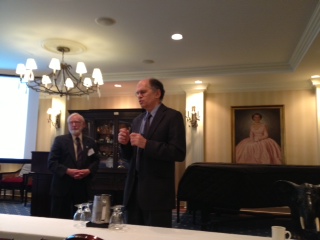
PPPL Director Stewart Prager described a host of scientific activities
at the Lab during a talk at the annual Fusion Power Associates (FPA)
meeting held in Washington, D.C. Steve Dean, the executive director of
FPA, can be seen to his left. (Photo credit: Kitta MacPherson, PPPL Office of Communications)
By Kitta MacPherson
By Kitta MacPherson
WASHINGTON, D.C. – What happens when the forces of fusion
gather?
At the annual meeting of the Fusion Power Associates, held
at the tony Capitol Hill Club in the shadow of the U.S. Capitol, there’s lots
of talk about “plasmas” and “hohlraums” and of devices called stellarators and other
machines with names like “Z.”
Starting yesterday and continuing through today, the leaders
of fusion energy research in the U.S. from U.S. Department of Energy-funded
laboratories, as well as from industry and publicly funded university programs, have been and will continue to
line up and present, in rigorously timed 20-minute-long segments, the state of
their art. Differences in approaches to
fusion from inertial confinement where pellets are zapped by lasers to magnetic
confinement where a superhot gas is corked in a magnetic bottle are described.
As competitive as the programs may be, all are regarded here as being under the
aegis of fusion--part of the ecumenical approach of Steve Dean, the founder and
executive director of the sponsoring group, the Fusion Power Associates.
The purpose of FPA, a non-profit foundation based in
Gaithersburg, Md., is, according to its website, to “ensure the timely
development and acceptance of fusion as a socially, environmentally, and
economically attractive source of energy.” The meetings are designed to
showcase management-level scientists and their technical achievements.
In the long narrow, federal style Eisenhower Room,
an observer in the space of several minutes can
hear a full range of approaches to fusion from some of its best minds.
Attendees can hear Mike Dunne, a leading scientist at the National
Ignition Facility based at
Lawrence Livermore National Laboratory in California, describe
scientific
advances in inertial fusion at the facility, pointing to diagrams
showing
cylindrical capsules called “hohlraums” that hold fusion fuel capsules.
One can
then listen to Stewart Prager, director of the Princeton Plasma Physics
Laboratory, convey elements of progress in magnetic fusion. The
Princeton lab is
focusing on areas with breakthrough potential where the U.S. can lead,
he said.
And lest anyone think that PPPL is overly focused on a doughnut-shaped
fusion reactor configuration known as a tokamak, Prager indicated his
commitment to also support
another configuration known as a stellarator. “We believe that
stellarators are
not a luxury item, we believe they are essential for fusion,” he said.
Observers at the meeting also can get a taste of the
international.
Ned Sauthoff, director of the U.S. ITER program, talked
about the importance of scientific research being conducted now to benefit
ITER, a mammoth experimental fusion vessel under construction in Cadarache,
France. “The science of ITER is happening now,” he said. “In order for it to
succeed, you have to have a strong program that is related to things like
burning plasmas.” The goal of ITER is to achieve 500 megawatts of fusion power.
The giant tokamak is being designed to demonstrate the scientific and
technological feasibility and safety features of fusion energy, Sauthoff said.
Tight budgets for domestic programs have leaders such as Miklos
Porkolab, director of MIT’s Plasma Science Fusion Center, expressing concerns.
“Vigorous research in the next decade is necessary on existing tokamak
facilities with upgrades in heating and current drive power as well as advanced
plasma diagnostics and tungsten plasma-facing components,” he said, adding that
much physics remains to be explored on existing tokamaks in order to optimize
ITER’s operation. The largest U.S. experimental magnetic fusion devices--at
MIT, PPPL, and General Atomics--are complementary, he noted, and need sustained
support.
In his presentation on fusion experiments at Los Alamos
National Laboratory, Glen Wurden said he is worried about the impact
of cuts to the domestic fusion program, especially in light of growing ITER
commitments, and the survivability of the U.S. plasma physics and fusion research
enterprise should there be additional cuts in future years. “We are dangerously
approaching the tipping point,” he said.
Mark Herrmann, a physicist at Sandia National Laboratory,
who was recognized for his research with an award from FPA, spoke with
excitement about his work on a 10,000 square-foot experimental fusion device
known as “Z”. “You have to be an optimist to be a fusion scientist,” he said
with a smile.
Thursday, September 6, 2012
Dr. Z weighs in on sun killers
Could
a supervillain destroy the sun that gives our planet life? When a writer for
the science website Life’s Little Mysteries pondered that question, he turned
to PPPL Deputy Director Michael Zarnstorff for his astrophysical expertise.
Zarnstorff dismissed such notions as poisoning the sun’s fusion reaction, or
siphoning off plasma to make the sun evaporate, as too far-fetched. But he said
creating a black hole in the center of Old Sol might conceivably do the trick.
To read how that would work, click here: http://www.lifeslittlemysteries.com/2844-star-destroying-superweapon.html
---
John Greenwald
Wednesday, May 23, 2012
U.S. Department of Energy's Plasma Science Center holds third annual meeting at PPPL
Graduate
student Hongyue Wang discussed her work on plasmas in Hall thrusters with
University of Michigan professor Mark Kushner during the third annual meeting of
the U.S. Department of Energy's Plasma Science Center at PPPL. Wang, a student
at Beihang University in Beijing, works with PPPL physicist Igor Kaganovich.
Kushner directs the Plasma Science Center. (Photo credit: Elle Starkman, PPPL Office of Communications.)
More than 50 participants from a dozen U.S. research institutions gathered at the Princeton Plasma Physics Laboratory (PPPL) May 17-18 for the third annual meeting of the U.S. Department of Energy’s Plasma Science Center. The meeting featured papers on low-temperature plasmas, whose practical applications range from lighting to nanotechnology. Events at the session included a display of graduate student posters and a tour of PPPL.
Thursday, April 26, 2012
A flame is a plasma, after all, so PPPL joins a contest
Andrew Zwicker, a physicist at PPPL who heads science education, working with Aliya Merali.
More than 800 scientists. Nearly 5,000 students.
That’s how many people are involved in what ABC news anchor Diane Sawyer has called “the most inspired contest on the planet.”
In March, actor Alan Alda wrote a provocative editorial in the renowned journal Science. The title of his column, “The Flame Challenge,” described how he, as an 11-year-old, stared at a candle flame and wondered what it was. He wasn’t looking for overly simple answers – he wanted a step-by-step style of conversation that would lead to understanding. When he queried one teacher he thought he could approach, he received a disappointing answer. “What’s a flame?” he asked. “Oxidation,” she said. Many decades later, he sees this continuing failure to properly communicate science as a society-wide problem.
For years, he has been doing his part to address that problem by hosting “Scientific American Frontiers” on public television. In the show, Alda interviews scientists about their work, helping them explain their research to intelligent non-scientists. Now, as a member of the faculty at the Center for Communicating Science at the State University of Stony Brook on Long Island, Alda has launched his own experiment. He announced the Flame Challenge contest (http://flamechallenge.org) in Science, asking scientists, educators, and students to submit short videos, essays or effective communications by any other means to explain the simple question he asked as a boy.
Andrew Zwicker, a physicist at PPPL who heads science education, came up with a version of the answer, working with Aliya Merali. You can view it here:
Submissions, which were due on April 2, have poured in from all over the world. According to a story on the website of the Center for Communicating Science, participants submitted 822 entries from the U.S. and 30 other countries. The entries range from a sentence to tomes and from poetry – one poem is written in the shape of a flame – to live-action videos with special effects. Once volunteer scientists screen the submissions for accuracy, the entries are being sent to schools where 11-year-olds at more than 130 schools will judge them. The finalists will be posted on flamechallenge.org, and the winner will be announced at the World Science Festival in New York, New York in early June.
-- Kitta MacPherson
Thursday, January 26, 2012
Wonder Weld
Engineers at the U.S. Department of Energy’s Princeton Plasma Physics Laboratory are using the process shown here to create a super-strong weld for the upgrade of a key component of the Lab’s experimental nuclear fusion reactor. The whirling steel tool in this demonstration joins two copper plates by heating them through friction to the consistency of wax. The roughened surface will be smoothed out in the finished product. Called “friction stir welding,” the process is critical to the upgrade of the test reactor that will enable Laboratory scientists to address major questions on the road to developing nuclear fusion as a safe, clean and virtually limitless source of energy for generating electricity. (Video by Edison Welding, Columbus, Ohio)
Friday, January 13, 2012
Snowflake Science
Let it snow! Scientists at the Princeton Plasma Physics Laboratory are using a novel device called a "snowflake divertor" to keep superhot gases from damaging the walls of a nuclear reactor during experiments to develop a safe, clean and virtually limitless fuel for producing electric power.
Read more...
Monday, January 9, 2012
Monday, December 19, 2011
Science on Saturday
Science on Saturday is a series of lectures given by scientists, mathematicians, and other professionals involved in cutting-edge research. Held on Saturday mornings throughout winter, the lectures are geared toward high school students. The program draws more than 300 students, teachers, parents, and community members each Saturday. Topics are selected from a variety of disciplines.
The program runs January through March, and is free and open to the public. Lectures begin promptly at 9:30 AM. Click here for the Science on Saturday 2012 schedule.
Saturday, November 19, 2011
Plasma lessons, crushed marshmallows and all
By John DeLooper
Today, Friday is the end of the conference. The last session concludes at about 12:30 p.m. There will be some additional satellite meetings but most folks will be leaving today and tomorrow (if we can get out with the expected snow storm…)
This was the second day of the Plasma Expo. It takes a lot of effort to get the students to this event. Teachers need to make the arrangements including organizing bus transportation and collecting permission slips. The plasma educators from the various laboratories arrange and run the Plasma Expo. In addition to the exhibitors, there are a number of individuals greeting the bus and escorting the students into the exhibit hall. They are the unsung heroes of the Plasma Expo! They help make sure that we track the students through the convention center.
More than 1,000 students attended the Expo today. As usual, our volunteers did a superb job. It’s not always easy explaining plasma to a middle school student and how the plasma in a fluorescent tube can be 10,000 degrees. It’s always wonderful when you see the look of amazement on a student's face when he or she sees something unusual (like crushed marshmallows or a Jacob’s ladder) and absorbs the scientific message. That makes our day.
Although the conference ended at 12:30 p.m., our Expo went beyond, til 2 p.m. At the conclusion, we took down our display, packaged our exhibit materials, and placed them on skids. Our graduate students helped the Science Education staff to dismantle the display. Although we try to mimic the great work our shipping folks did in sending the material to us, we hope that the skids get back to the lab safely…. we’ll know in about a week!
My thanks to the Science Education staff, our scientists, post-docs, and graduate students for all of their help in a successful educational outreach effort!
--John DeLooper is the head of outreach and best practices at PPPL.
Friday, November 18, 2011
Plasma Expo: More 1,400 learn about the fourth state of matter
By John DeLooper
Today is the first day of the plasma expo. Over 1,400 students, both middle and high school, attended. Students visited each of the various exhibitors. In some cases they came to learn more about plasmas and fusion. In other cases they had specific questions that they had to answer. We supply these questions to the teachers so that they can make sure their student does go to each exhibitor. Students typically spend an hour and half visiting the exhibits.
The expo starts at 8:30 a.m. and goes to 2 p.m. Although the science education staff arranges the set up, the real key to our success are the scientists, post docs and graduate students who staff the exhibit and explain the plasma exhibits to the students. Without their help, this would never be as effective and impactful for the students. For their service we are very grateful. The pictures reflect the expo as it evolves. Sometimes we are waiting for students and then we are very busy. At one time during the morning there were six individuals behind the table talking to more than 24 students at the same time. It is pretty hectic during those time frames.
During the day, the scientific meeting continues with presentations and poster sessions.
We reopened the exhibit for the public in the evening between 6 and 8 PM. This allows teachers and parents to bring their students who couldn't come during the day as well as anyone else who would like to attend. Attendance varies widely from each meeting and the city it is located in. The exhibitors run a pool to guess the number of visitors we'll have in the evening session which was so congratulations to Tom from Oak Ridge and Aliya from Princeton who shared the $18 pool!
After the evening plasma expo a number of exhibitors moved up the block to see the choir rehearsal of the world famous Mormon Tabernacle Choir. The choir practice is every Thursday evening between 8:00 and 9:30 p.m. It is open and free to the public. The choir consists of 360 individuals supported by a full orchestra and a pipe organ that has more than 11,600 pipes. This was very impressive.
Tomorrow is another expo day and then we get to pack up and go home.
--John DeLooper is the head of outreach and best practices for PPPL
Thursday, November 17, 2011
Setting up for the Big Day and Recognizing Student Poster Winners
By John DeLooper
(Reporting from the American Physical Society meeting this week in Salt Lake City)
PPPL's Plasma Expo display: The calm before the storm
Today was a relatively easy day. Stephanie Wissel, Aliya Merali, Deedee Ortiz and I set up the PPPL booth for the Plasma Expo which will happen Thursday, Nov. 17. This involves unpacking two pallets of supplies containing more than 600 pounds of materials and setting up our display (as shown in the photo) and building the plasma displays we will use to teach students about plasma, the fourth state of matter. We are expecting more than 1,200 students each day. In addition, we will open the display to the public on Thursday evening.
While staff from PPPL and other research centers – including General Atomics, Massachusetts Institute of Technology, the Nevada Test site, University of Wisconsin, and ITER—worked to set up displays, the meeting continued with presentations and posters sessions.
This evening the banquet will occur. The featured speaker will be Alan Nathan who will speak on the Physics of Baseball. But the more important item will be the announcement of the winners of the student poster competition.
Here are the winners, out of 76 contenders:
• “Study of Sheath Potential and Plasma Density Profiles in the Presence of Strong Secondary Electron Emission from Walls” by Huy-Sinh Trung, University of Virginia, research conducted at PPPL.
• “Breaking the Four-fold Symmetry in the Paul Trap Simulator Experiment”, Stewart Koppel, University of Texas at Austin, research conducted at PPPL.
• “Simulation of Shear Alfen Waves in LAPD using the BOUT++ code”, Di Wei, University of Denver, research conducted at UCLA.
• “Ramifications of Driven Spontaneous Flow and Turbulent Transport on Cross-correlation Functions in the Large Plasma Device”, Giovanni Rossi, UCLA, research conducted at UCLA.
• “Oscillation Modes of a Relativistic Drifting Cold Plasma”, Michael Meyers, Drake University, research conducted at Los Alamos.
• “Optimization of Neutron Activation of Carbon at the NIF, Danae Polsin and Megan Russ”, SUNY Geneseo.
It is also important to recognize the mentors for the 76 posters. Each student had one or more mentors who devoted 10 weeks of time and effort. This is critical—it’s how we bring new scientists into the research world.
--John DeLooper is the head of outreach and best practices at PPPL
Wednesday, November 16, 2011
Teacher’s Day
By John DeLooper
The morning started very early. I got to visit with my fellow hotel guests at about 1:15 a.m. when the fire alarm went off – no fire, just a false alarm. Today is an outreach day. We have more than 60 teachers here. After an introduction, they attended a workshop to cover the basics of plasma – our Plasma 101 course. It is given by three individuals – the groups are broken up into middle school teachers, high school and advanced high school. I presented the middle school session using PowerPoint slides, movies, and hands-on demos. There were 33 teachers in the session with several visitors (folks who help run the Teacher’s Day event, including Deedee Ortiz from the PPPL Science Education group). Workshop topics included– cosmology, fusion demonstrations for the classroom, the electromagnetic spectrum, light and nature of matter, understanding Newton’s laws, and Stars: Plasma physics in the sky. Here, teachers learn about the electromagnetic spectrum in a lecture by Rick Lee from General Atomics.
All of the teachers have lunch with one or two scientists at each table. These are scientists who are attending the conference.
Teachers ask questions and learn. A couple of gifts are given away – three $50 coupons to buy supplies, a couple of plasma balls and some money to buy a lighting fixture. The fixture will be used to hold a half-coated fluorescent lamp given to the teachers by the Coalition for Plasma Science. It is part of a goodie bag of information and supplies given to the teachers at the end of the day. Teachers will also have an opportunity to bring their students to the plasma expo which will be held on Thursday and Friday.
This afternoon the educational poster session occurred. This allows students who have worked at the Laboratory or another research organization to present their results to the scientific community. Thirty-one students supported by PPPL programs presented their research at this poster session. In addition, three of our PPPL science educators presented posters on our work – Andrew Zwicker, Stephanie Wissel and Aliya Merali. The students’ posters are judged by scientists (the students don’t know who is judging) and the best are recognized in a student appreciation session at 6 p.m. (Just another long but worthwhile day at APS!)
In addition to these activities, there was another full day of technical sessions, posters and other meetings conducted through the day.
--November 15, 2011
John DeLooper is the head of outreach and best practices at PPPL
Tuesday, November 15, 2011
APS Plasma Physics meeting kicks off with NSTX science
By John DeLooper
Welcome to the 53rd Annual Meeting of the American Physical Society Division of Plasma Physics being held in Salt Lake City, Utah. This meeting is the biggest meeting in the U.S. for scientists to report their results when it comes to plasma science and fusion energy results. Over 1,650 individuals are here from around the world to give presentations and review information with their colleagues through poster sessions.
The meeting days are long. Today we started at 8 a.m. with a review talk. Then the meeting breaks up into sessions. This morning, there were three presentation sessions, a poster session and a mini-conference on geospace plasmas. One of the morning sessions was on the National Spherical Torus Experiment at PPPL. The room was filled with over 250 individuals while presentations were made by NSTX team members (both PPPL staff as well as a number of our collaborators).
This afternoon there was another session starting at 2 p.m. and going to 5 p.m. Then there was another meeting and presentation by the University Fusion Association that started at 7 p.m. Ed Synakowski, the Head of the US DOE Office of Fusion Energy Sciences made one of the presentations at this meeting.
This is very different from any other meetings I’ve attended. Everything is timed and listed in the program. So individuals may listen to one presenter in a particular session and then move to another session to specifically listen to another author. So it is not uncommon for fifty or so individuals to move after a particular presentation. The program book listing all of the talks and posters seems to weigh about 4 pounds!
Today is also a day of preparation. Tomorrow, we will be hosting teachers from the local school district for a day of professional development to learn about plasmas. I make a presentation to middle school teachers on plasma 101 and fusion energy. So today we have to find all of the supplies we shipped and get the material ready for teachers day. The wonderful news was our supplies had arrived and after checking them and moving them into my “classroom” everything worked after a few minor repairs.
--- November 14, 2011
John DeLooper is head of outreach and best practices at PPPL
Friday, October 21, 2011
PPPL's MINDS Technology Takes Nuclear Detection to the Marketplace | Department of Energy
A software system designed by the Energy Department's Princeton Plasma Physics Laboratory (PPPL) originally to help decommission a nuclear reactor is now on its way to helping federal authorities detect hidden nuclear materials, including "dirty bombs," in airports and shipping terminals around the world.
Read on...
Wednesday, October 5, 2011
It’s a gas….PPPL in the news
Is there really a helium shortage or is it all a lot of hot air? The Trenton Times examined the issue, interviewing one of our experts, Mike Williams, associate director of engineering and infrastructure at PPPL. Cornell University physicist Robert Richardson got the story going, predicting that the world’s helium supply will dwindle to zero within a quarter of a century. Williams pointed out that the “shortage” was created by a 1996 federal action opening up reserves stockpiled since the Cold War. “The law let (the United States) sell off its reserves willy-nilly, and now our reserves are actually dwindling,” Williams told the Trenton Times. Williams is not worried. The Lab uses the liquid form of the element for vacuum pumping and recycles a lot of the material.
For the full story, go here: Link
Coming soon…A Roadmap to Fusion
Hutch Nielson, director of advanced projects for PPPL, reported in the ITER Newsline (http://www.iter.org/newsline/191/852) that 65 fusion researchers from 10 countries came to Princeton University’s McDonnell Hall last month to map out the path to commercial fusion energy. The International Workshop, “MFE (Magnetic Fusion Energy) Roadmapping in the ITER Era,” was organized by Nielson and other members of an international committee of fusion leaders and hosted by PPPL. “With the ITER project now launched on its mission to answer outstanding questions regarding the control of burning plasma, the countries engaged in fusion research are planning, with renewed intensity, the research and major facilities needed to develop the science and technology for harnessing the fusion energy from a burning plasma for commercial use,” Nielson writes. A summary of the workshop is being prepared for publication and a list of participants and all of the presentation material is available here: Link
-- Kitta MacPherson
Sunday, July 31, 2011
The Adventure Ends on a High Note
By John DeLooper
This was the last day of the great microgravity adventure.
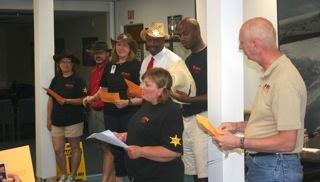
Each team was required to make a presentation on its work activity. It could be in any format, but ingenuity was encouraged. Twelve teams were required to present. Some teams chose PowerPoint presentations, and some home-made movies. The Space Cowboys chose to have a campfire and a sing-a-long with s'mores!
We did have some VIP's in the audience including Kumar Garg, a policy analyst from the Office of Science and Technology Policy, and Leland Melvin, an astronaut who is now the Associate Administrator for Education in NASA.
When it was our turn, my wonderful teammates invited Leland to become an honorary Space Cowboy - he accepted and helped us perform our campfire songs. Our team performed the classic, "Fly Zero - G," "We've Been Working on our Project," and "Fly, Fly, Away," each with great audience participation. A picture of the Space Cowboys including Leland is below - he's in the white shirt with a tie and cowboy hat.
So here are the words to "Fly Zero - G" (to the tune of "Home on the Range"):
Oh, give us our meds,
For our dizzying heads,
So we can fly and not worry or puke
Where our team's never late
And our projects just great
And our data is accurately clear
Fly, fly, zero g
Where we'll float and then we will spin
With bubbles galore
Coils, springs and much more
And we're ready to do this again.
After our songs, we thanked the NASA and DOE for this wonderful opportunity. It was truly an amazing experience.
But the work was not done yet. We still had to pack all of our hardware up and get it ready for shipment. As we did that, we took one last picture of all the teams associated with the Department of Energy with our hosts from the Reduced Gravity Office. All of the team members signed the banner which will now be hung in the high bay of the RGO.
Now we are done. Allison is on her way home. The rest of us travel tomorrow. The adventure is complete. But a few of us are already thinking of ideas and possible funding to get other experiments on this wonderful laboratory! Thanks to the RGO for a wonderful experience and a great memory!
Subscribe to:
Posts (Atom)
.png)